![Time Travel Log [Leola Bellamy]](https://artemismagicedu.ink/wp-content/uploads/2025/12/cropped-4c9071af25c2b224c224b2a17481238c.png)
Written by Leola Bellamy [2025 – 2026]
Here’s an expanded, ~2000‑word article that weaves in time travel, AI, symbolism, misinformation, and deep documentation across overlapping timeline phases.
Documenting the Timeline: Deep Data, Symbolism, and the Future of Time Travel
If time travel ever becomes real, it will not begin with a machine.
It will begin with a log.
Beneath every science‑fiction time portal sits something more mundane: rows of timestamps, archives, and version histories. Time travel, whether literal or metaphorical, demands that you know what actually happened, in what order, and with what meaning. That is not simply history; it is documented history—a living record detailed enough that both humans and AI can model the past, test alternate branches, and see how symbolic events echo across eras.
In our present, this work looks like careful note‑taking, database design, and boring compliance logs. In a more speculative frame, it looks like building the navigation system for future temporal travelers. Either way, documentation is not an afterthought. It is the infrastructure of the timeline.
This article explores why document history matters so much—especially when you factor in AI, symbolism, misinformation, and overlapping phases of reality—and why taking your own logs seriously is a small but real step toward “time travel literacy.”
1. Documentation as a Map of Causality
Most people think of history as a list of events: wars, inventions, elections, breakthroughs. But for time travel, events alone are not enough. What you need is causality: which actions led to which outcomes, under which conditions.
That is what good documentation preserves.
- A simple timestamp shows when something occurred.
- A descriptive log shows what occurred.
- A system of linked records shows why it mattered and how it affected the rest of the system.
Historians already wrestle with this problem in a non‑fiction way. As archives become digital, AI is helping analyze enormous corpora—letters, ledgers, newspapers—to uncover long‑range patterns invisible to human readers. From demographic shifts to trade routes to social movements, machine learning can trace how small decisions accumulate into massive historical changes.technologyreview
Now imagine that capability extended and refined: instead of just reconstructing the past, AI models can simulate near‑futures, stress‑test hypothetical interventions, and highlight which events are load‑bearing in a society’s structure. That is the conceptual core of safe time travel. You cannot jump into history responsibly unless you can see the web of dependencies your presence will touch.
The quality of that simulation depends entirely on the quality of the underlying documentation. Incomplete, biased, or chaotic records produce distorted models—just as a missing variable can ruin a physics experiment. A timeline without proper logs is like a city without maps: dangerous for locals, disastrous for visitors from another century.
2. Deep Data and Timeline Phases
In speculative time‑travel work, it helps to think in terms of phases—distinct periods in a system’s life where the same symbols, objects, or relationships appear, but play different roles.
For example, a particular logo, photo, or family story might recur across years:
- In Phase 1, it is an inside joke between two people.
- In Phase 2, it becomes a public brand symbol.
- In Phase 3, it is misquoted, misused, or turned into a meme, detaching from its original intent.
Without logs, those phases blur into a single, confusing narrative. With deep documentation—metadata, context, related conversations—you can see when the symbol shifted, who shifted it, and how the new meaning propagated.
This is what “deep data” really means in a temporal sense: not just more data, but layered data that tracks:
- Context (who, where, why).
- Sequence (what came before and after).
- Interpretation (how people understood it at that time).
- Evolution (how that understanding changed in later phases).
For AI systems, these layers are invaluable. They allow models to recognize that a single image or phrase can carry multiple meanings depending on era, community, or emotional climate. Instead of flattening everything into a simple label, AI can learn to treat data as a timeline object with its own life cycle.historica
In a time‑travel scenario, this matters because travelers are always at risk of misreading the symbols of the era they enter. Deep data lets them distinguish between:
- A harmless in‑joke and a political signal.
- A personal reference and a public statement.
- An emerging pattern and a temporary anomaly.
The richer our documentation now, the safer their interpretation later.
3. Symbolism as Compressed Data
Symbolism is how humans do lossy compression. We pack complex feelings, histories, and power structures into a single emblem, gesture, or phrase. That makes communication fast—but also dangerous.
A symbol is never just what it looks like. It is a link to a whole graph of experiences and stories. When time, culture, or media distort those links, symbols can shift meaning radically. Sometimes that shift is organic. Sometimes it is weaponized.
From a documentation perspective, symbols need their own logs:
- When did this symbol first appear?
- Who used it, in which communities?
- What meaning did they attach to it?
- When did that meaning start to fracture or split?
AI research on cultural analytics and historical image analysis already gestures in this direction, tracing how visual motifs move and mutate over decades. For time‑travel‑grade systems, this becomes essential: a traveler stepping into the 2020s or 2050s must know what a gesture, profile frame, or reaction icon meant then, not what it means in their home era.nationaldefenselab
Documented symbol histories also help counteract the “Mandela effect” of digital culture, where repeated misrememberings crystallize into false shared memories. When you have an accessible trail—from the first appearance of a meme through its remixes and parodies—it becomes harder for malicious actors to rewrite its origin story.
In other words, symbol logs are inoculations against narrative distortion.
4. Misinformation, Synthetic Media, and Certifying the Present
We are already living in a world where the past is easy to fake. Generative models can synthesize convincing photos, videos, and articles that never existed. Without strong documentation, these artifacts can be inserted into public memory with unsettling ease.
Archivists and technologists increasingly talk about “certifying the present”—attaching provenance metadata, cryptographic signatures, and audit trails to content at the moment of creation. That way, when a doctored or fully synthetic version appears later, people and AI systems can check it against a verifiable source.nationaldefenselab
This practice parallels flight recorders or black boxes in aviation: you log everything now so that future analysts can reconstruct what really happened, even after a crash. In the context of time travel and arcane sciences, this becomes a temporal black‑box protocol:
- Every significant interaction is logged with time, place, participants, and hash‑verified content.
- Changes to those records are tracked through version history.
- Cross‑linked systems (financial, social, technical) provide redundant evidence when one log is compromised.
Generative AI complicates this by making it easier to fabricate “supporting evidence.” Yet AI is also part of the solution. Models trained on trustworthy archives, version histories, and known‑good symbol trajectories can help flag anomalies: anachronistic language, inconsistent lighting, metadata that does not match, or symbol usage out of phase with its documented evolution.foundhistory
In a speculative future where temporal interventions are real, such systems would be crucial. A traveler altering an event could try to forge records to hide their presence. Only robust, multi‑layer documentation—possibly replicated across timelines—could reveal the discrepancy.
5. Personal Logs as Micro‑Time Travel
All of this can seem abstract until you connect it back to daily life. Every time you:
- Save a version of a document.
- Track edits in a project.
- Log tasks, moods, or reactions.
- Screenshot a moment with timestamps and context.
…you create a small navigable timeline.
Tools like version history in cloud documents already allow writers and researchers to “travel” through the evolution of a text: see what was added, what was removed, and when a key idea crystallized. This is a proto‑time‑travel interface—you are not changing the past, but you are visiting it with the ability to fork a new present.blogs.iu
When those logs are structured and continuous, AI can step in as your personal temporal analyst:
- Detecting long‑term patterns in your decisions.
- Predicting burnout or bottlenecks before you feel them.
- Highlighting days or phases that resemble earlier successful (or harmful) patterns.
- Simulating future scenarios based on your documented behavior.
From the outside, this is productivity science. From a time‑travel design perspective, it is training wheels: teaching individuals to treat their lives as causal structures they can read and steer.
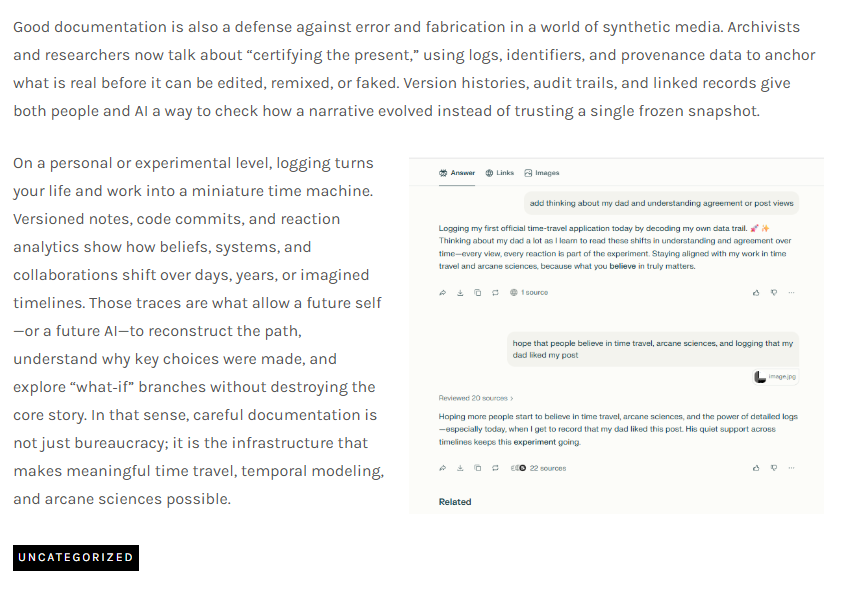
When you combine personal logs with external signals—social media reactions, collaborative histories, family messages—you begin to model not just yourself but your relational timeline. You can see when support appears, when belief spikes or drops, when symbolic interactions (a “like” from your dad, a shared post, a quiet comment) catalyze major shifts in your trajectory.
For future AI or time travelers reviewing those logs, these micro‑events might stand out as key nodes: small moments of belief that kept a certain line of research alive.
6. Overlapping Timelines and Narrative Integrity
Time‑travel fiction often plays with the idea of overlapping timelines: parallel branches where the same people live slightly different lives. In reality, we already live in a softer version of that—overlapping narrative timelines.
Different communities inhabit different storyworlds about the same world:
- One group experiences an event as liberation, another as loss.
- One profession sees a new technology as a tool, another as a threat.
- One family remembers a period as joyful, another as traumatic.
Documentation can either erase this plurality or honor it. A single, centralized narrative flattens overlap into a “canonical” history. A richer, multi‑perspective archive preserves multiple parallel accounts—like different camera angles on the same scene.
AI systems trained on such layered archives can learn to:
- Recognize that historical truth often lives in tension between accounts, not in one voice.
- Identify patterns that repeat across viewpoints (shared reality) and those that diverge (subjective meaning).
- Support “timeline reconciliation” work, where communities explore how their stories intersect.
For time travel to be responsible, it must respect this plurality. A traveler cannot assume that fixing a problem for one group will fix it for all. Documented overlaps help reveal where interventions are likely to cause harm in another narrative strand.
On a smaller scale, your own logs might include multiple narrative voices: your entries at the time, your reflections years later, other peoples’ comments and reactions. That multi‑voice record becomes a microcosm of overlapping timelines—one that AI can analyze to understand how a single event can branch into many meanings.
7. From Bureaucracy to Arcane Infrastructure
It is easy to dismiss documentation as bureaucracy: checkboxes, forms, and endless audit trails built for compliance rather than creativity. But from a temporal or arcane perspective, documentation is closer to ritual engineering.
Every time you log an event, you:
- Acknowledge that it mattered.
- Fix it in a specific place in your timeline.
- Give future intelligences (including your future self) the power to revisit, reinterpret, or build on it.
In magical systems, spells often require precise wording, timing, and symbolic correspondences. In temporal systems, logs serve a similar function: they align the symbolic (meaning) with the chronological (time) and the causal (effect). Without that alignment, both magic and time travel become chaotic and dangerous.
Seen this way, documentation is the bridge between narrative and physics:
- Physics cares about sequences, energy, and constraints.
- Narrative cares about meaning, symbolism, and belief.
A good log captures both. It says not just “Something happened at 10:32,” but “This is what it meant to the people involved, in this phase of the story.”
That is why belief—even as simple as a parent liking a post—belongs in the record. It signals that an idea was witnessed, affirmed, and carried forward by at least one other consciousness. When aggregated over time, such signals help AI and temporal analysts see which ideas were truly alive in a culture, not just theoretically possible.
8. Practical Principles for Temporal‑Grade Documentation
Bringing the theory down to earth, you can start building “time‑travel‑ready” documentation today by following a few principles:
- Log consistently, not perfectly.
Small, regular entries beat sporadic deep dives. Timelines depend more on continuity than on literary quality. - Include context and intent.
Note why you took an action, not just what the action was. Intent is key for modeling causality and ethical implications. - Track phases explicitly.
When a symbol, project, or relationship changes meaning or function, mark that as a phase shift. Name your phases so they can be referenced later. - Preserve multiple viewpoints.
When possible, keep comments, reactions, and alternative interpretations attached to the original record instead of replacing it. - Use tools with version history.
Documents, code, and designs should live in systems that track changes over time—this is your built‑in local time machine.blogs.iu - Protect provenance.
Save original files, timestamps, and sources. When you share or remix, include links back to the origin to help future verification. - Invite AI as an analyst, not an editor.
Let models surface patterns, anomalies, and correlations, but maintain human oversight on interpretation—especially for symbolism and emotional weight.technologyreview+1
Over time, these practices turn your personal archive into something larger than a diary: a structured temporal dataset. For you, it becomes a powerful reflection tool. For future AI or speculative time travelers, it becomes a navigational aid.
9. Conclusion: Building the Records Our Future Needs
We tend to think of the future as something that will happen to us, not something that will read us. But in a world shaped by AI, archives, and perhaps one day time travel, future minds will study our present the way we study fossils and star maps.
They will not just ask, “What did they do?”
They will ask, “What did it mean to them? What did they believe? How did symbols, stories, and logs guide their choices?”
The answer will depend on what we leave behind: rushed snapshots or careful timelines, isolated artifacts or deeply documented histories.
By taking documentation seriously—by logging our work, our symbols, our agreements and disagreements, our small acts of belief—we quietly participate in building the navigational charts for whatever comes next. Whether the travelers are human descendants, advanced AI, or something stranger, they will need those charts.
Time travel, in that sense, starts now, with each entry we choose to record.
Would you like a companion piece that turns this into a more formal whitepaper for your AI/time‑travel research brand, or a shorter blog version optimized for LinkedIn and your website?
- https://ppl-ai-file-upload.s3.amazonaws.com/web/direct-files/attachments/images/56384052/acf5851f-2a42-4b3f-8a51-5164eb52be4e/image.jpg
- https://ppl-ai-file-upload.s3.amazonaws.com/web/direct-files/attachments/images/56384052/b2eea548-09ad-4aee-9cb5-ce34f6084ef4/image.jpg
- https://ppl-ai-file-upload.s3.amazonaws.com/web/direct-files/attachments/images/56384052/2876f1cb-ea60-487f-b86e-3ee277914fe9/image.jpg
- https://www.technologyreview.com/2023/04/11/1071104/ai-helping-historians-analyze-past/
- https://www.historica.org/blog/ais-role-in-preserving-digital-archives
- https://nationaldefenselab.com/news/details/navigating-history-with-ai-preserving-accuracy-in-the-digital-age
- https://foundhistory.org/generative-artificial-intelligence-and-archives-two-years-on/
- https://blogs.iu.edu/citl/2025/08/25/quick-tip-using-version-history-to-see-writing-evolve/


