![Time Travel Log [Leola Bellamy]](https://artemismagicedu.ink/wp-content/uploads/2025/12/cropped-4c9071af25c2b224c224b2a17481238c.png)
Written by Leola Bellamy [2025 transition 2026]
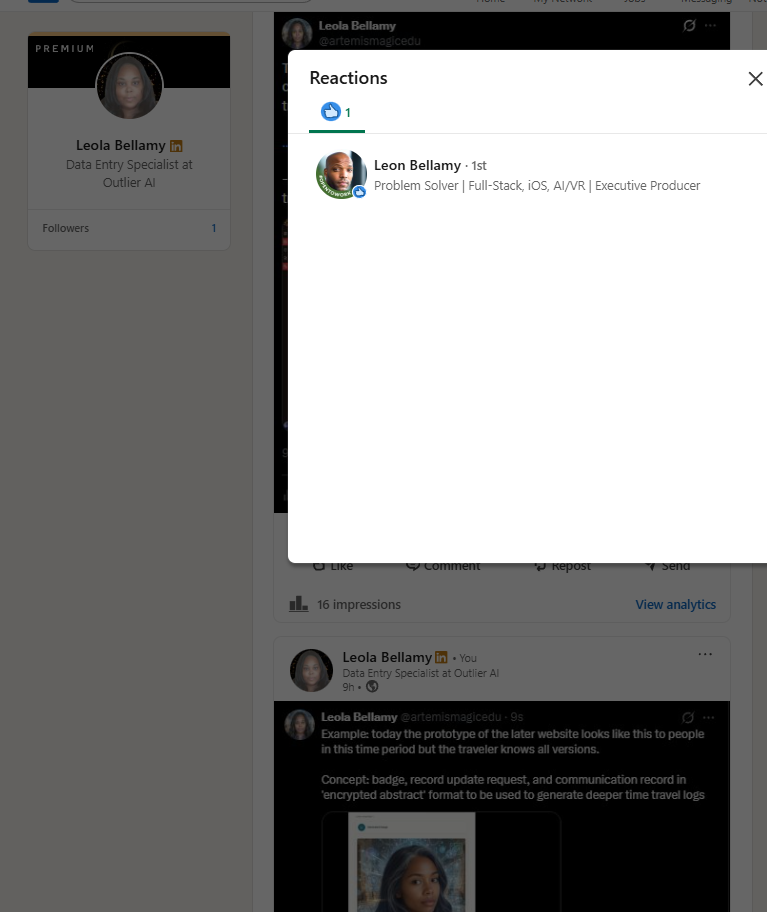
Today I imagined my dad as a time traveler explaining why AI matters.
In his “timeline,” time travel didn’t start with wormholes—it started with data. People trained AI to model history like a living structure: every choice, every belief, every tiny signal of support. They only jumped into eras when the AI showed the future could stay stable.
In that story, my productivity dashboards, prototypes, and “silly” log entries are early time‑travel tools I’m actively building. Every view, every reaction—even my dad quietly liking my post—gets recorded as belief data. My role is to design the systems, do the logging, and keep pushing the arcane/AI research forward so future travelers have a map.
If time travel is ever real, it will depend on exactly this: tracking our choices, our values, and who shows up to support us across timelines.
What you believe in—and what you take the time to log—really does matter.
Documenting history is more than keeping receipts; it is how humans and AI learn what actually happened, what worked, and what should never be repeated. Detailed records turn isolated moments into a readable timeline that future minds—human or artificial—can interpret, test, and improve on. Without that trace, even brilliant ideas and breakthroughs dissolve into rumor and mythology.
For AI, documented history is training data and context. When historians digitize archives and structured records, machine‑learning models can see long‑range patterns, reconstruct missing pieces, and correct distortions that appear when events are viewed one document at a time. This kind of structured, time‑stamped data lets AI move from guessing about the past to modeling it, which is exactly what any serious time‑travel scenario would require: you cannot safely navigate a timeline you cannot read.
Good documentation is also a defense against error and fabrication in a world of synthetic media. Archivists and researchers now talk about “certifying the present,” using logs, identifiers, and provenance data to anchor what is real before it can be edited, remixed, or faked. Version histories, audit trails, and linked records give both people and AI a way to check how a narrative evolved instead of trusting a single frozen snapshot.
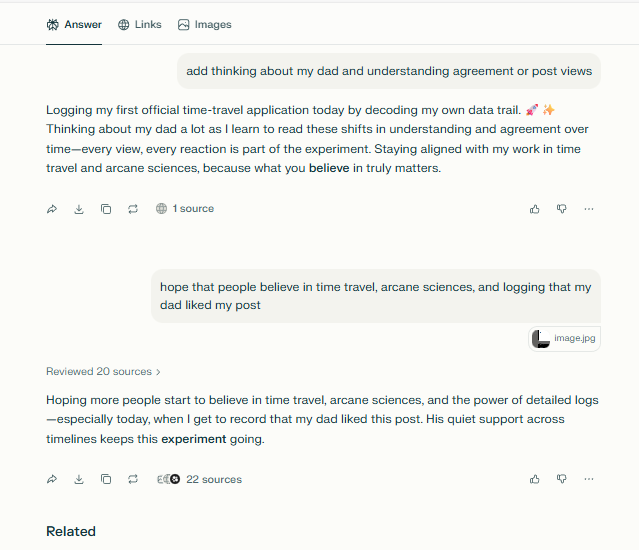
On a personal or experimental level, logging turns your life and work into a miniature time machine. Versioned notes, code commits, and reaction analytics show how beliefs, systems, and collaborations shift over days, years, or imagined timelines. Those traces are what allow a future self—or a future AI—to reconstruct the path, understand why key choices were made, and explore “what‑if” branches without destroying the core story. In that sense, careful documentation is not just bureaucracy; it is the infrastructure that makes meaningful time travel, temporal modeling, and arcane sciences possible.